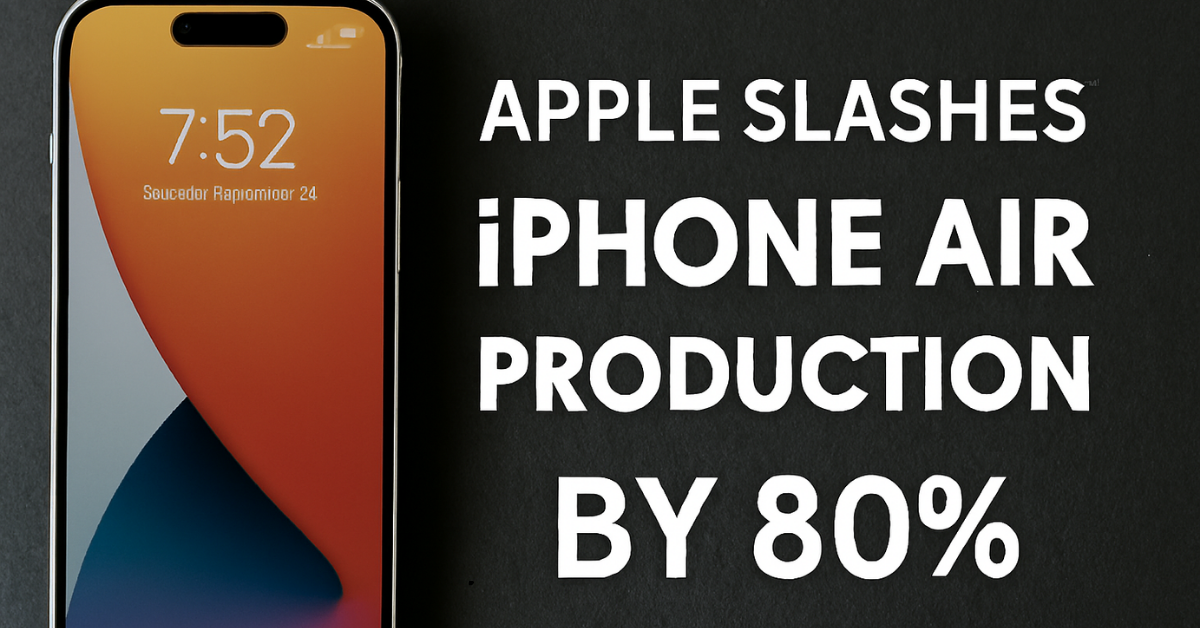
If you’ve been keeping an eye on Apple’s latest innovations, the iPhone Air probably caught your attention. Marketed as the slimmest iPhone ever, it promised elegance, portability, and a fresh take on premium design. But just weeks after its launch, Apple has made a surprising move—cutting iPhone Air production by a staggering 80%.
Let’s unpack what happened, why the iPhone Air didn’t meet expectations, and what this means for Apple’s future in the smartphone market.

A Bold Launch That Fell Flat
Apple introduced the iPhone Air as part of its 2025 lineup, hoping to carve out a new niche between the standard iPhone 17 and the Pro models. With a thickness of just 5.6mm, it was the thinnest iPhone ever made. The device was expected to account for 10–15% of Apple’s total iPhone production this year.
But despite the hype, the iPhone Air failed to resonate with consumers. Reports from Nikkei Asia and MacRumors confirm that Apple has drastically reduced production orders, with some suppliers receiving notices to cut back by over 80%.
Why Did the iPhone Air Struggle?
There are several reasons why the iPhone Air didn’t take off:

- Limited Market Reach: The iPhone Air was only shipped to select markets—China, India, and the U.S.—which restricted its global exposure.
- Premium Pricing: Despite its slim profile, the iPhone Air came with a high price tag, making it less appealing compared to the more feature-rich iPhone 17 and 17 Pro models.
- Compromised Features: Early adopters pointed out drawbacks like shorter battery life and a single rear camera, which didn’t justify the premium cost.
- Overlapping Demand: Analysts believe that the iPhone 17 series already meets most high-end user needs, leaving little room for a new segment like the iPhone Air.
In short, the iPhone Air didn’t offer enough value to stand out in a competitive market.
Supply Chain Shake-Up
Apple’s decision to cut iPhone Air production has sent ripples through its supply chain. Component suppliers and electronics module manufacturers have been asked to scale back orders significantly. Some have even received notices that production for November and beyond will be less than 10% of September levels.
This sudden shift highlights how quickly Apple can pivot when a product doesn’t perform as expected. It also underscores the importance of consumer feedback in shaping future product strategies.
What Analysts Are Saying
Tech analyst Ming-Chi Kuo, known for accurate Apple predictions, stated that the iPhone Air’s poor performance has led to capacity cuts across most suppliers. He estimates that reductions may exceed 80% by Q1 2026.
Kuo also noted that Apple is now refocusing its efforts on the iPhone 17 and 17 Pro models, which continue to perform well in global markets. This strategic pivot suggests that Apple is doubling down on what works, rather than trying to force innovation that doesn’t resonate.
Is This the End of the iPhone Air?
While Apple hasn’t officially discontinued the iPhone Air, the production cuts indicate that the device may not see a long future. Some components with longer lead times are already being phased out, and there’s little indication that Apple will push the model in new markets.
However, the iPhone Air might still serve as a stepping stone toward future innovations—like Apple’s rumored foldable iPhone, expected in 2026.
Lessons for Apple and Consumers
The iPhone Air’s journey offers valuable insights:
- Innovation Must Meet Demand: Slim design alone isn’t enough. Consumers want a balance of aesthetics, performance, and value.
- Market Testing Is Crucial: Launching in limited regions may have hindered broader feedback and adoption.
- Listening to Users Pays Off: Apple’s quick response shows its commitment to adapting based on real-world performance.
For consumers, this episode is a reminder to look beyond the hype and evaluate whether a new device truly meets their needs.
What’s Next for Apple?
Despite the setback, Apple remains a dominant force in the smartphone industry. The iPhone 17 series is performing well, and the company is already preparing for its next big leap—possibly a foldable iPhone in 2026.
Apple’s ability to innovate, learn from missteps, and pivot quickly ensures that it will continue to shape the future of mobile technology.
Final Thoughts
The iPhone Air was a bold experiment, but not every innovation hits the mark. Apple’s decision to cut production by 80% reflects a willingness to course-correct and focus on what truly matters to users.
As we look ahead, Apple’s journey reminds us that even tech giants must stay grounded in user experience. Whether you’re a loyal Apple fan or a curious observer, the story of the iPhone Air is a fascinating glimpse into the fast-moving world of consumer tech.
Disclaimer
This article is based on publicly available news reports and analyst insights as of October 23, 2025. All product details, production figures, and future plans are subject to change. Readers are encouraged to verify updates directly from Apple or trusted news sources.